Fort Mill has grown fast, with big newer homes, lakeside communities, and a historic center. We handle water extraction, structural drying, and repairs across Fort Mill, Tega Cay, and York County.
Fort Mill's housing is mostly newer and large, with planned communities and homes on or near Lake Wylie. The leaks are different from those in older towns. Pick the closest match.
Baxter and similar
Baxter Village and other planned communities
Large two- and three-story homes with upstairs laundry, tight mechanical closets, and finished bonus rooms are typical. A failed hose or condensate line can soak several floors, and HOAs are often part of the response.
We dry every level the water touched and coordinate with your HOA where needed.
What we often see
Upstairs washer and supply lines
Water heater and HVAC closet leaks
Condensate lines over finished rooms
Tega Cay and Lake Wylie
Homes on and near Lake Wylie and in Tega Cay
Houses on slopes toward the lake often have walk-out lower levels, docks, and irrigation. Rain runoff, high humidity, and hidden outdoor plumbing add to the usual leaks.
We find the entry point, dry the lower level, and check inside walls and floors for moisture.
What we often see
Rain runoff entering walk-out levels
Dock and irrigation plumbing leaks
Humidity and condensation in lower rooms
Downtown Fort Mill
Downtown Fort Mill and its older neighborhoods
Older houses and small commercial buildings around the center have aging plumbing, older roofs, and crawl spaces. Slow leaks are common and are often found only after a stain or smell appears.
We trace moisture to its source, dry the structure, and repair finishes with care.
What we often see
Aging supply and drain lines
Damp crawl spaces and soft subfloors
Old roofs and chimney flashing
Attached housing
Townhomes, condos, and apartments along Highway 160 and Regent Parkway
Shared walls, ceilings, and mechanical systems mean leaks and smoke cross unit lines. Neighbors, HOAs, and several insurers are often involved.
We document each affected unit and work with managers and HOAs.
What we often see
Leaks from the unit above
Water heater and supply line failures
Condensate backups between units
Away from home
Back from a trip to a wet house?
In large homes, a leak can run for days before anyone sees it. These steps help.
Do
Shut off the main water valve right away.
Avoid wet areas until power to them is off.
Film a slow walk-through before anything is moved.
Contact your insurer and note when you found the damage.
Call us so drying can start immediately.
Don't
Don't walk into rooms with sagging ceilings.
Don't throw out damaged items before they are documented.
Don't wait to see whether the damp spots dry.
Don't rely on fans alone to dry wet walls.
What we are called for
What we are called for in Fort Mill.
Upstairs appliance leaks
A hose lets go and the water runs through two floors.
Water heater failures
A tank splits in a garage or closet and floods the surrounding rooms.
AC condensate overflows
A clogged line spills into an attic, closet, or ceiling.
Rain runoff on sloped lots
Water collects at walk-out levels and garage doors.
Frozen outdoor lines
A short hard freeze splits irrigation and exterior lines.
Storm-damaged roofs
Wind-driven rain gets past shingles and flashing.
Fort Mill weather
Why Fort Mill buildings get wet.
Rain and the lake
Thunderstorms can drop heavy rain on slopes that drain to the lake and creeks.
Remnants of tropical systems in late summer and fall can saturate York County for days.
Clay soil drains slowly, so water collects against foundations and in lower levels.
Properties near the water or creeks should check mapped flood zones.
Heat, humidity, and cold snaps
Long hot summers keep air conditioners running and condensate lines busy.
Humid air slows drying, so we measure moisture instead of trusting touch.
Occasional hard freezes can split pipes and irrigation lines.
Yes. We work across Fort Mill, including Baxter Village, Downtown Fort Mill, Regent Parkway, Fort Mill Parkway, Highway 160, and Springfield. Call us for current availability for your address.
Yes. We work in Fort Mill, Tega Cay, Baxter Village, Springfield, and the Lake Wylie area. Call us for current availability for your address.
Yes. We coordinate access with the HOA, document each affected home, and provide a written scope of work.
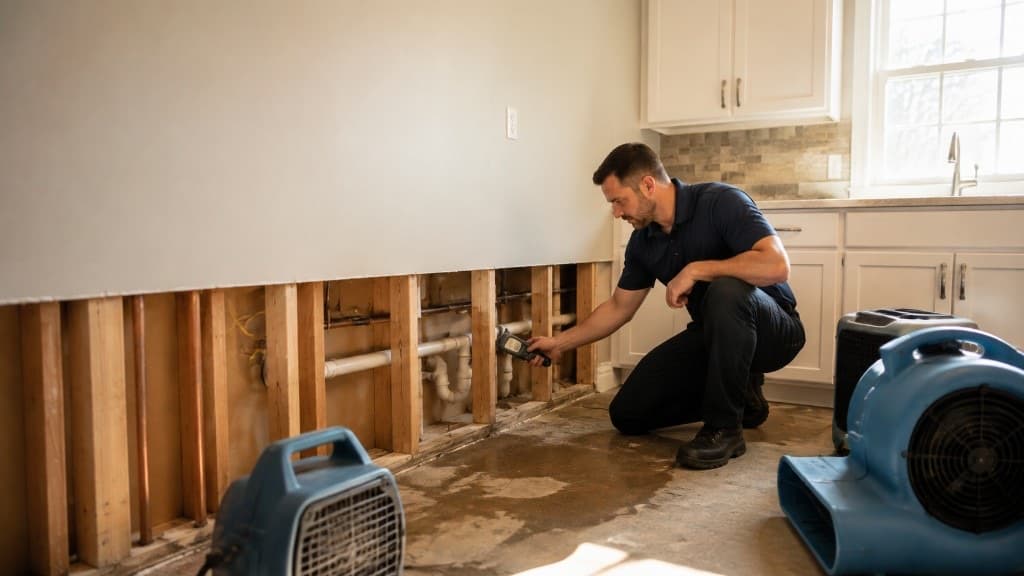
We remove standing water, take out materials that cannot be saved, dry the structure with equipment, and measure moisture until it is back to normal. Finished lower levels hold water, so thorough drying matters.
In general, flood damage requires its own flood policy rather than a standard homeowners policy. Check your policy and ask your insurer; coverage depends on the wording and on your property.
Yes. We serve both sides of the state line, including Charlotte, Rock Hill, and Pineville. Call with your address and we will confirm availability.
It depends on the policy and on what caused the water. A burst pipe and a long-term drip are often handled differently, and flooding from outside is usually a separate policy. We provide photos, readings, and a written scope for your insurer.
Possibly. A ceiling stain proves water reached that spot, not that water is still arriving. We can check with a meter and tell you what we find.
Yes. The crew that dries your property can also rebuild it, from drywall and flooring to trim and paint.
Water damage, fire damage, and mold restoration, plus remodeling, for homes and businesses across the Charlotte metro. One team from emergency cleanup to the finished repair.